Friday, April 23, 2010

It would be unnatural NOT to use technology! (by Dayle)

Response to: "online learning can quite often be unproductive due to reliance on technologies that fail to work effectively"
I would argue that it is actually the opposite, online learning is becoming more productive due to the increasing availability and improvement of technologies. Using Skype as an example:
  • It allows us to meet in a class situation even though we are all in our own locations
  • It allows participants to share links to relevant materials at the time they are being discussed
  • It promotes interaction between students and student-teacher; we can text chat while someone is speaking allowing commentary without directly interrupting the speaker
  • It allows for the recording of a class for future reference and revision
The fact that there are occasional technical difficulties is a problem whether you are online or not. I have been to many lectures where technology has failed - projectors, laptops and even lecture theatre microphones are prone to the same technical problems as in the online environment. Teachers usually manage to go on - the skype session referred to was continued using text chat. Most of our modern life activities have some reliance on technology but we usually decide the advantages outway the hurdles, even if we still like to complain loudly. Are we suffering from the 'Everything's amazing and nobody's happy' syndrome? Fifteen years ago universities were just beginning to offer email, now we have lms's, online classes, lecture recording etc. Complaints about technology malfunctioning are a temporary problem that is being resolved quickly.

Response to: "the internet is still a relatively slow way to communicate and present to a class"

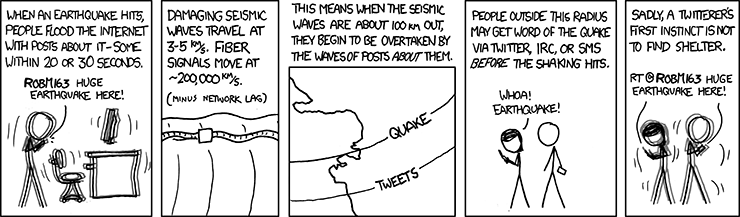
How exactly is the internet slow in comparison to other methods? The internet makes accessing information infinitely faster than days gone by. Without the internet and the LMS for most university subjects we would have look up each of the readings in the library - let's say it takes 10 minutes to find each one, and there are perhaps 100 references per subject... well that's a long time! Using the internet we can show a video, play music or reference a book by simply sending someone a hyperlink. The argument about download times is becoming increasingly defunct as internet connections improve. In a 2009 survey of 794 students from various disciplines at the University of Adelaide it was found that 97% had broadband internet access at home (Hall, 2009). Besides which, the internet is just FAST - fibre signals move at ~200,000 km/ps!

Technology is a normal part of our working, social and family lives, it would actually be unnatural NOT to use it in education. I put it to you that technology is not the real issue, it's pedagogy that counts (Preskett, 2010). Technology is a tool, like textbooks and blackboards and it is all about how it's used that makes for good education. You can have excellent learning and teaching experiences online or you can have terrible ones, just as with face to face learning and teaching. Today's technologies provide us with tools to enable more participatory and collaborative learning experiences.

References

Hall, D 2009, MyMedia Student Evaluation 2009, Centre For Learning and Professional Development, http://www.adelaide.edu.au/clpd/resources/reports/MyMediaStudentEvaluation2009.pdf
Louis C K 2009, 'Everything's amazing and nobody's happy', Late Night with Conan O'brien, http://www.youtube.com/watch?v=8r1CZTLk-Gk
Preskett, T 2010,
'Thoughts on 'Innovating the 21st-Century University: It’s Time!', Educational Technology and Change Journal, http://etcjournal.com/2010/03/06/3719/
Munroe, R 2010, 'Seismic Waves', http://imgs.xkcd.com/comics/seismic_waves.png

Tuesday, April 20, 2010

Disadvantages of E-learning (by Phil)

Ok, we need to acknowledge that online learning can quite often be rather unproductive due to the over reliance on technologies that fail to work effectively. I would like to remind you of an online class I attended on Thursday 15th April where the lecturer's microphone was misbehaving and as a result the intended learning couldn't take place as planned.

Refer to the following statement be Ted Clark, "My sound dropped out etc." (http://app.lms.unimelb.edu.au/webapps/portal/frameset.jsp?tab_id=_2_1&url=%2fwebapps%2fblackboard%2fexecute%2flauncher%3ftype%3dCourse%26id%3d_184348_1%26url%3d)

This type of learning is always going to be at the mercy of internet connections (fast or otherwise slow), microphones that are not being recognised by certain software and anything and everything else which makes up an electronic system designed to allow people to communicate.

"Technology can be a blessing or a curse" (http://www.grayharriman.com/e-learning_advantages.htm#2) and another major problem is the internet bandwidth available. In other words, the internet is still a relatively slow way to communicate and present a class (i.e. learning materials, discussions etc.)

I can recall an eluminate course I attended through Kangan Institute last year which was a complete disaster because my brand new Macbook didn't like the bigpond modem I was using and kept 'dropping out'. In the end I gave up. Would probably have preferred a face-to-face class instead...much more reliable and effective don't you think?

References:

(http://app.lms.unimelb.edu.au/webapps/portal/frameset.jsp?tab_id=_2_1&url=%2fwebapps%2fblackboard%2fexecute%2flauncher%3ftype%3dCourse%26id%3d_184348_1%26url%3d)

(http://www.grayharriman.com/e-learning_advantages.htm#2

The Pros and Cons of online learning, e-learning, cyber learning and any other term(s) that describe it!

Hi Everyone,

Dayle and I (Phil) will be conducting a debate on the advantages and disadvantages of online learning, learning using technologies etc. I guess there really is no definitive answer as to which mode of learning is "better" as online learning will always suit some students and not others....BUT....the real question is...who will provide the most convincing argument??

Only you can be the judge of that. Let's begin!